

A Bittersweet Symphony
Turning Marmalade on Toast into a Tart

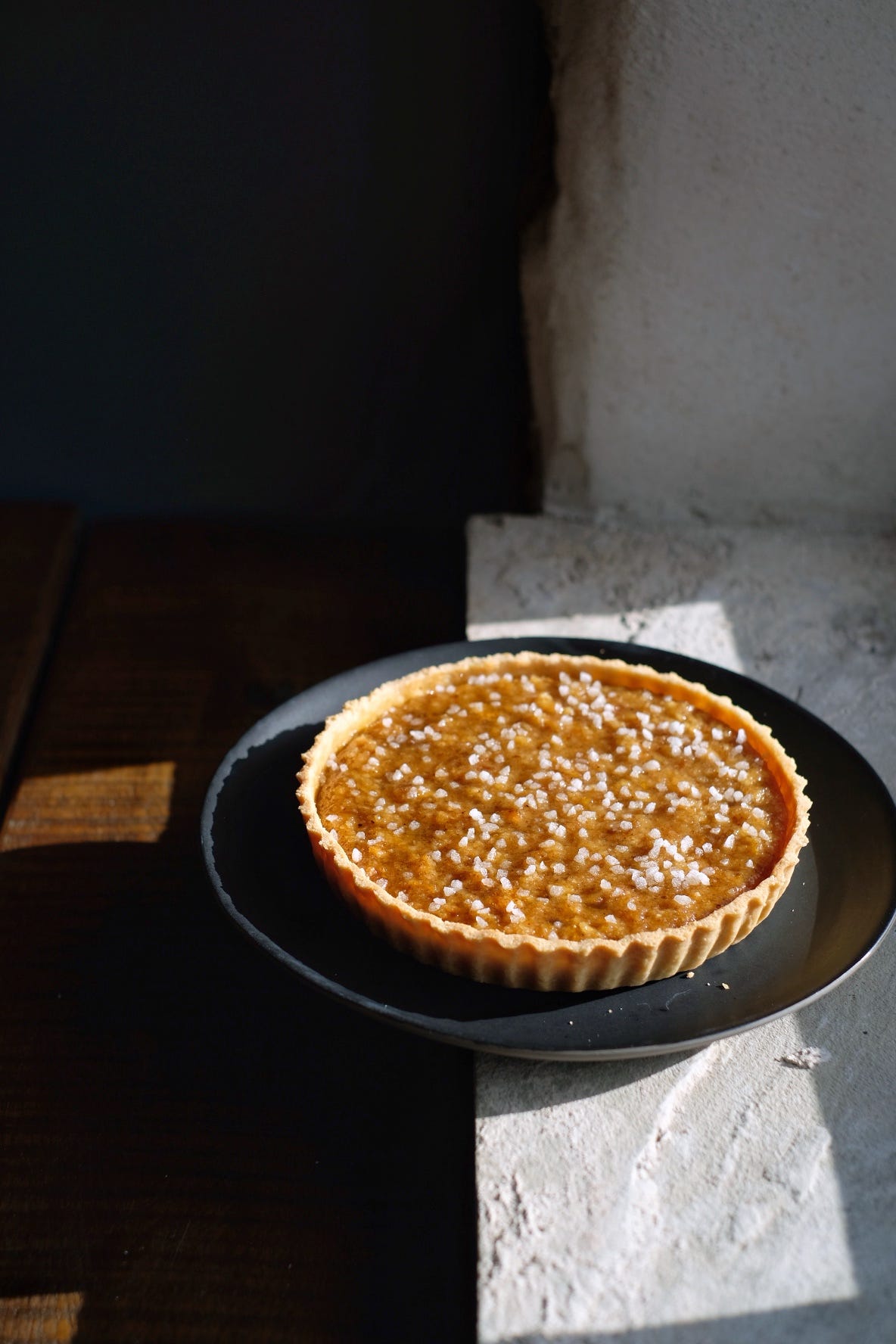
For a while now I have longed to turn marmalade on toast into a dessert – think treacle tart, but swapping some of the golden syrup for marmalade, and toasting the bread before pulverising it. Though I must admit, while writing this recipe up, I remembered that I already made something along these lines for one of my supper clubs at Barn Kitchen a few years ago. I served that version with a tea-infused crème Anglaise, which was so perfect, but with the week I’ve had (laminating pastry, running out of ADHD medication, teaching a class of 10 wonderful students at my baking school) I just haven’t had the time to slowly stir a pot of milk, eggs and vanilla and cook it to precisely 85°C. That kind of precision might just have finished me off.
I made two of these tarts this week (with my long-suffering partner of 15 years, Paul, chatting beside me for our podcast – listen here) and the first had double the amount of marmalade. It was lovely, but just a little too much on the bitter side. Had I used a cheaper, sweeter marmalade, it would probably have worked well, but I like my marmalade how I like my men: zesty and mouth-puckeringly sharp. On that note, I used Frank Cooper’s (I don’t know him, nor is he paying me to write this…) fine cut Oxford marmalade. The rind in that, as the name suggests, is fine enough to be inoffensive, yet present enough to impart a little texture and much orange flavour (though, I do amp that with some added orange zest).
The result is a really imaginative riff on a treacle tart. Even my mother, who is more critical than the lovechild of Prue Leith and Paul Hollywood, loved it.
Marmalade on Toast Tart
Serves 8
For the pastry
150g Italian 00 flour (or plain)
100g unsalted butter, diced
50g 0% Greek yoghurt (or buttermilk)
1 small egg, beaten, to glaze
For the filling
100g sliced white bread
60g butter
175g marmalade (I used Frank Cooper’s Oxford marmalade)
200g golden syrup
Zest of 1 medium orange
1 tsp vanilla bean paste
60g milk
1 large egg
½ tsp fine salt
¼ tsp nutmeg
To finish
2 tbsp marmalade
2 tsp water
Pearl sugar (optional)
Equipment
20cm/8-inch fluted tart tin (preferably one with a loose bottom)
I’d highly recommend making the pastry in a food processor with blade attachment. The speed and the cutting mean the pastry comes together quickly and stays quite cold, removing the need to chill it before use. If, however, you find yourself without a food processor, do make it by hand. But if the pastry warms up too much and gets soft, it’ll need 30 minutes or so in the fridge before you use it.
Making the pastry in a food processor
Put the flour and salt into a food processor fitted with blade attachment and pulse together to mix. Add the butter and pulse until evenly dispersed and you have a fine, breadcrumb consistency. Add the yoghurt (or buttermilk) and pulse until the mixture starts to form a damp sand consistency. Continue until it begins to clump together in little pebbles then stop. Tip the pastry onto the worktop and force it together into a smooth dough with your hands – you shouldn’t need any extra flour at this stage. The pastry should be cold and firm enough to use immediately.
Making the pastry by hand
Put the flour and salt into a mixing bowl and whisk together – if the flour is particularly lumpy, pass it through a sieve. Add the butter and rub it into the flour with your fingertips. Stop once you have a fairly even sandy consistency (it’s ok for there to be a few pea-sized lumps of butter here and there). Tip in the yoghurt (or buttermilk) and use a breadknife or palette knife to ‘cut’ the wet ingredients into the dry. Once it starts to clump together, tip it onto the worktop and force it into a smooth dough with your hands – you shouldn’t need any extra flour at this stage. The pastry may still be cool and firm enough to use immediately, but if it feels a little soft, flatten it into a disc, wrap it in cling film or baking paper, and refrigerate for 30 minutes.
Blind baking the pastry
Lightly dust the worktop and the pastry. Roll the pastry out into a disc that is 3mm thick – turn the pastry 45° every couple of rolls to ensure it forms a neat circle. Use it to line the 20cm/8-inch tart tin, ensuring the pastry is tucked right into the corner where the base meets the sides. Trim the excess pastry leaving a little overhang of about 1cm, then press the pastry into the grooves of the tin with a stiffened finger. Let the surplus pastry hang over the edge of the tart tin – don’t force it down because that could pull the pastry inside the tin out from the corners.
Prick the base of the pastry repeatedly with a fork – this is known as ‘docking’. Line the pastry with a few sheets of oven-proof cling film or baking paper that has been scrunched up and unfolded (this makes it easier to press neatly into the tin). Be sure that whatever you use has surplus overhanging all edges of the pastry. Fill the cling/paper completely full with uncooked rice (don’t bother with ceramic baking beans) then wrap the surplus cling/paper up around the rice to encase it.
Put the tin onto a baking sheet and put into a cold oven. Turn the oven to 180°C fan and let the pastry bake for 30 minutes. After this time, carefully remove the baking beans in their cling/paper parcel, then glaze the entire inside surface area of pastry with beaten egg. Return the tin to the oven for a further 20 minutes, until the pastry is cooked through and a very pale golden colour. Remove from the oven and allow the pastry case to cool.
Reduce the oven to 160°C fan.
Making the filling and baking
Toast the bread well – either in the toaster or under the grill - until deeply golden brown but not burned. Allow to cool then blitz to fine crumbs in a food processor.
Brown the butter: first have a sink of cold water ready to cool the pan down when the butter is done. Then, melt the butter in a small saucepan over a medium heat. Once melted, increase the heat to high and allow the butter to bubble – swirl the pan every 15 seconds or so to prevent the milk solids from burning. As the butter boils, the excess moisture will evaporate, and when the bubbling stops and is replaced by a drier, crackling sound, accompanied by a fine, cappuccino-like foam on the surface of the butter, and a gentle nutty smell, remove the butter from the heat. It should also be a golden-brown colour. Plunge the base of the pan into the sink of cold water; though, don’t get any water in the pan. This will help to cool the pan down and stop the butter burning.
Add the marmalade, golden syrup and orange zest to the pan with the butter, and set over a medium heat. Stir the pan to make the marmalade and syrup runnier – don’t worry if the butter doesn’t emulsify at this stage. Remove from the heat and allow to cool slightly, then add the remaining ingredients (including the toast crumbs) and beat until well combined. Pour the mixture into the blind baked pastry case, then bake at 160°C fan for 25-30 minutes, until slightly puffed up and only just set.
Remove the baked tart from the oven and allow to cool completely, then make the glaze. Put the marmalade into a saucepan with the water and heat through until runnier. Paint the glaze over the cooled tart with a pastry brush. Finish with a scattering of pearl sugar, if using.